The Australian GST Formula Explained (With Examples)
Learn the exact formulas for adding and removing 10% Australian GST. Includes worked examples, the divide-by-11 shortcut, and why rounding matters.
Quick Answer: To add GST: multiply by 1.10. To find the GST amount: multiply by 0.10. To remove GST from an inclusive price: divide by 1.10. To extract GST from an inclusive total: divide by 11. These formulas match ATO guidelines exactly.
Australian GST has been 10% since 2000. The maths sounds simple, but there are two distinct operations (adding and removing), and the rounding rules matter when you're reconciling a BAS with cents across dozens of transactions. This guide covers both formulas precisely, with worked examples.
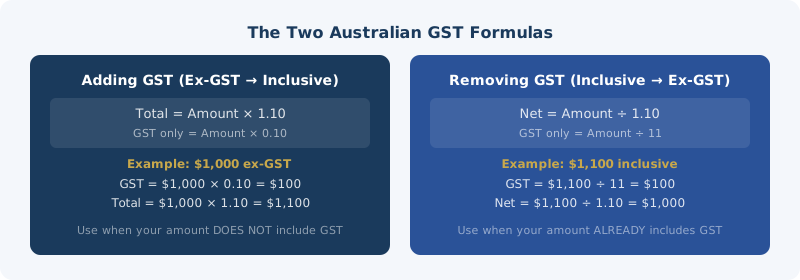
The Two GST Formulas
Every GST calculation falls into one of two types:
Type 1. Adding GST to a GST-exclusive price:
You have a net price (before tax) and need to find the GST-inclusive total.
Type 2. Removing GST from a GST-inclusive price:
You have a total that already includes GST and need to extract the tax component and/or the net price.
These are the only two scenarios. Our Australian GST calculator handles both with a single dropdown selection.
Type 1: Adding GST
When a price does not yet include GST (common for B2B quotes, wholesale pricing, contractor fees), use:
GST amount = price × 0.10
Total (incl. GST) = price × 1.10
Worked examples
| Ex-GST price | GST (×0.10) | Total (×1.10) |
|---|---|---|
| $100.00 | $10.00 | $110.00 |
| $550.00 | $55.00 | $605.00 |
| $1,200.00 | $120.00 | $1,320.00 |
| $4,999.50 | $499.95 | $5,499.45 |
For $550: GST = $550 × 0.10 = $55.00. Total = $550 × 1.10 = $605.00.
The multiplier 1.10 works because you're adding 100% of the original price plus 10%: 1.00 + 0.10 = 1.10.
Type 2: Removing GST
When a price already includes GST (retail receipts, invoices marked "GST inclusive"), use:
Amount (excl. GST) = inclusive price ÷ 1.10
GST amount = inclusive price ÷ 11
The divide-by-11 shortcut
This is the most useful mental-maths trick for Australian business. The GST is exactly 1/11th of any GST-inclusive price.
Why? Because when you add 10% to a base price, the base becomes 100/110 = 10/11 of the total. The GST component is the remaining 1/11.
Proof: $100 base + $10 GST = $110 total. GST as fraction of total = $10 ÷ $110 = 1/11.
Worked examples
| Incl. GST price | ÷ 11 (GST) | ÷ 1.10 (Ex-GST) |
|---|---|---|
| $110.00 | $10.00 | $100.00 |
| $605.00 | $55.00 | $550.00 |
| $1,320.00 | $120.00 | $1,200.00 |
| $2,200.00 | $200.00 | $2,000.00 |
For $2,200: GST = $2,200 ÷ 11 = $200.00. Net = $2,200 ÷ 1.10 = $2,000.00.
Check: $2,000 + $200 = $2,200. ✓
Rounding Rules
The ATO doesn't mandate a specific rounding approach for every transaction, but standard practice is:
- Round GST amounts to the nearest cent (two decimal places)
- Round half-cents up (standard Australian banking convention)
- Don't round intermediate calculation steps; only the final result
Where rounding matters: if you have 50 line items each with a small GST component, rounding each line item independently and then summing can produce a different total than calculating the GST on the sum of all items. Both approaches are generally acceptable, but consistency within your accounting system is important.
A rounding example
An invoice has three lines: $99.90, $45.40, $12.95 (all GST-inclusive).
Method A (line-by-line):
- $99.90 ÷ 11 = $9.0818... → rounds to $9.08
- $45.40 ÷ 11 = $4.1272... → rounds to $4.13
- $12.95 ÷ 11 = $1.1772... → rounds to $1.18
- Total GST: $9.08 + $4.13 + $1.18 = $14.39
Method B (total first):
- Total = $99.90 + $45.40 + $12.95 = $158.25
- $158.25 ÷ 11 = $14.3863... → rounds to $14.39
Same result here, though they often differ by 1 cent for larger invoices. Neither is wrong; it's an artefact of rounding. Our GST calculator calculates to full precision and rounds the final result, consistent with Method B.
Why 1/11th Works: The Algebra
For those who want to understand rather than just remember the formula:
Let the GST-exclusive price = P.
GST rate = 10% = 0.10.
GST amount = P × 0.10.
GST-inclusive price = P + P × 0.10 = P × 1.10 = T (total).
To recover the GST from T:
GST = T − P = T − T/1.10 = T × (1 − 1/1.10) = T × (0.10/1.10) = T × (1/11).
So GST = T/11. QED.
This is why the "divide by 11" shortcut is exact. It's not an approximation, but rather the algebraic consequence of a 10% rate applied to the exclusive price.
When to Use Each Formula
Use Type 1 (add GST) when:
- You're writing a quote or invoice for a B2B client who will claim back the GST
- Your pricing is structured as ex-GST (common in wholesale, professional services, trade)
- You've been given an ex-GST figure to put on a tax invoice
Use Type 2 (remove GST) when:
- You received a GST-inclusive invoice and need to separate the tax for your records
- You're working backwards from a retail price to find the base cost
- You're completing a BAS and need the GST component of purchases to calculate credits
Both are on our GST calculator. Just pick your scenario from the dropdown and enter the amount. For more practical context on how these formulas apply to invoices, read our guide on how to write a GST invoice. To understand why input tax credits work the way they do, see our guide to claiming GST credits.
Key Takeaways
The two Australian GST formulas are simple once you know which direction you're going. To add GST to a net price: multiply by 1.10 for the inclusive total, or by 0.10 for the GST component alone. To remove GST from an inclusive price: divide by 1.10 for the net, or divide by 11 for the GST component.
The "divide by 11" shortcut is exact, not approximate. It follows directly from the algebra of a 10% rate. The GST is always exactly 1/11th of any GST-inclusive price in Australia.
For rounding, apply it only to the final result. Rounding each line item before summing can produce a 1-cent discrepancy compared to rounding the total, but both methods are acceptable in practice.
If you need to verify a GST calculation before putting it on an invoice or into a BAS, our Australian GST calculator handles both directions instantly. No sign-up required, no ads in the way. For more background on who built this tool and our methodology, visit our about page.
Understanding these formulas is the foundation of working with Australian GST. Once you've got them, tasks like completing a BAS, checking a supplier invoice, or writing a compliant tax invoice become much more straightforward.
When the Formulas Are Most Useful
Knowing the formulas matters most in three practical situations. First, when you're preparing a quote and need to show a price both with and without GST. Second, when you've received a GST-inclusive invoice and need to record the GST component separately in your accounting system. Third, when you're completing a BAS and need to verify the credit amounts on your purchase records.
In each case, the formula is the same. Add GST: multiply by 1.10. Remove GST: divide by 1.10 (for the net amount) or divide by 11 (for just the GST). Every mainstream Australian accounting package applies these formulas. Now you know why they work, not just how to use them.
The ATO's published guidance confirms these formulas in their GST guides for small business. Nothing changes if the amount is $50 or $500,000 - the same multipliers apply at every price point.