How to Claim GST Input Tax Credits on Business Expenses
Learn when you can claim GST input tax credits on Australian business purchases. Covers eligibility rules, tax invoice requirements, partial credits, and BAS reporting.
Quick Answer: Claim GST input tax credits on your BAS for any business purchase where GST was charged, you hold a valid tax invoice, and the purchase was for a creditable business purpose. You cannot claim credits on personal use, GST-free supplies, or input-taxed supplies.
If you pay $1,100 for business software and the invoice includes $100 GST, that $100 is your money back. You paid it on behalf of the government and you're entitled to reclaim it. That's the fundamental idea behind input tax credits, and why GST-registered businesses have a structural advantage over unregistered competitors when buying business supplies.
What Is an Input Tax Credit?
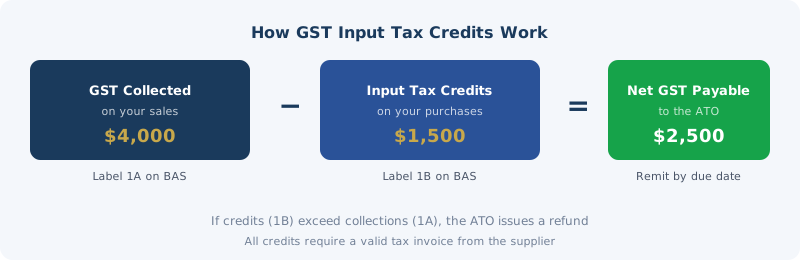
An input tax credit (ITC) is the GST you've paid on a business purchase that you can claim back from the ATO. It offsets the GST you've collected on your sales. On your BAS:
- GST collected on sales = what you owe
- Input tax credits = what you're owed
- Net GST = the difference (you pay the net, or receive a refund if credits exceed collections)
For example: you collected $4,000 GST on sales this quarter. You have $1,500 in input tax credits from business purchases. You remit $2,500 to the ATO.
This mechanism means GST is effectively only paid once: by the final consumer. Each business in the chain collects GST from the next buyer and claims back the GST it paid to its suppliers. Use our Australian GST calculator to verify the GST component of any purchase before recording it.
Four Conditions to Claim a Credit
The ATO requires all four of these to be met:
1. You are GST-registered. Credits are only available to registered businesses. If you're not registered (turnover below $75,000 and you haven't voluntarily registered), you cannot claim credits. See our guide on GST registration.
2. The purchase is for a creditable purpose. The item must be used in carrying on your business, and not for making input-taxed supplies (more on this below). Personal purchases (even if made on a business card) don't qualify.
3. GST was included in the price. You can only claim a credit if the supplier charged GST. Purchases from unregistered suppliers, GST-free supplies, and input-taxed supplies carry no GST, so there's nothing to claim. The invoice should show the GST amount clearly.
4. You hold a valid tax invoice. For purchases over $82.50 (GST-inclusive), you need a tax invoice from the supplier before you can claim. A receipt showing the ABN and GST amount counts. A supplier who won't provide a tax invoice is a red flag, as they may not be registered for GST themselves.
What Counts as a Business Purchase
Most regular business expenses qualify:
- Office supplies, stationery, printing
- Software subscriptions and digital tools
- Professional services (accounting, legal, consulting)
- Equipment and machinery
- Vehicles used for business purposes
- Business travel and accommodation
- Advertising and marketing
- Repairs and maintenance on business assets
- Mobile phone and internet (proportional to business use)
- Rent on commercial premises
The purchase doesn't need to relate directly to a specific sale. General overhead costs (like office rent or accounting fees) are fully creditable.
Partial Credits: Mixed Personal and Business Use
When an expense is partly personal and partly business, you can only claim the business-use proportion. The most common examples:
Mobile phone: If your phone is 70% business use, you claim 70% of the GST on your monthly bill.
Home office: If you work from home and use a room 40% of the time for business, the GST on utilities, internet, and phone can be claimed at 40%.
Vehicle: If a car is 60% business use based on a logbook, 60% of the GST on running costs (fuel, servicing, insurance, registration) is claimable. Note: the "car limit" applies to the purchase of vehicles, so check current ATO limits for the year.
The ATO accepts reasonable estimates for mixed-use items, but keeping records (call logs, logbooks, calendar evidence) protects you if questioned.
What You Cannot Claim
Personal purchases. A business card charge at a restaurant for a personal dinner is not creditable. A business lunch with a genuine client is.
GST-free supplies. If you buy fresh produce for your cafe from a wholesale market, there's no GST on the purchase, so there's no credit to claim. See our guide on GST-free items for the full category list.
Input-taxed purchases. If you're a property investor renting residential property (input-taxed supply), you cannot claim credits on property-related costs such as maintenance, agents' fees, and repairs. This is a frequently misunderstood rule.
Entertainment expenses. Meal entertainment and entertainment facility leasing costs have specific rules and are often denied as business deductions and credits. FBT implications apply.
Recording Credits for Your BAS
For each creditable purchase, you need to record:
- Date
- Supplier name and ABN
- GST-inclusive amount
- GST amount (= inclusive total ÷ 11)
- Description of what was purchased
- Invoice/receipt reference number
Your accounting software should capture this automatically. For manual record-keeping, a simple spreadsheet with these columns works.
At BAS time, sum your GST amounts from all creditable purchases for the period. This is your 1B figure on the BAS.
Quick example for a quarter
| Purchase | GST-incl. | GST (÷11) |
|---|---|---|
| Accounting software annual | $1,320.00 | $120.00 |
| Office rent (3 months) | $8,250.00 | $750.00 |
| Printer and toner | $440.00 | $40.00 |
| Mobile phone (70% business) | $297.00 | $27.00 |
| Professional fees | $2,200.00 | $200.00 |
| Total | $12,507.00 | $1,137.00 |
1B on your BAS = $1,137.00. Verify each figure with our GST calculator if needed.
Claiming Credits in Arrears
You can claim a credit in a later BAS period if you missed it initially, as long as:
- The credit is claimed within four years of the date it arose
- The original tax invoice is held
You don't need to amend a previous BAS for a missed credit. Just include it in your current period and note it appropriately in your records.
Staying on top of credits quarterly is far easier than reconstructing four years of records. Work with a BAS agent or accountant if you're finding the tracking difficult; their fees are creditable too. For a complete picture of BAS lodgment, see our BAS step-by-step guide.
Key Takeaways
Input tax credits let you reclaim the GST you've paid on business purchases. The four conditions are: you're GST-registered, the purchase is for a creditable business purpose, GST was included in the price, and you hold a valid tax invoice for purchases over $82.50.
The most common mistakes are claiming credits on personal expenses mixed in with business ones, claiming credits without a valid tax invoice, and attempting to claim credits on input-taxed supplies like residential property costs.
For mixed-use items (phone, internet, home office, vehicle), only the business-use proportion is claimable. Keep records that support your claimed percentage.
Credits are claimable up to four years after the original BAS period. If you missed credits in prior quarters, include them in your current BAS period rather than amending past returns.
Use our GST calculator to verify the credit amount on any purchase. For a $4,400 GST-inclusive invoice, the credit is $4,400 ÷ 11 = $400. Visit our about page to understand more about the methodology behind our tool.
Keep your business and personal expenses clearly separated from the start. The more disciplined you are about this, the faster your BAS preparation becomes and the lower your audit risk.