What Items Are GST-Free in Australia? Complete List
A complete guide to GST-free supplies in Australia. Find out which goods and services carry no GST, including food, medical services, and exports.
Quick Answer: GST-free items in Australia include most basic foods, some medical and health services, most education courses, childcare, exports, and water/sewerage services. You don't charge GST on these, but you can still claim input tax credits on costs to provide them.
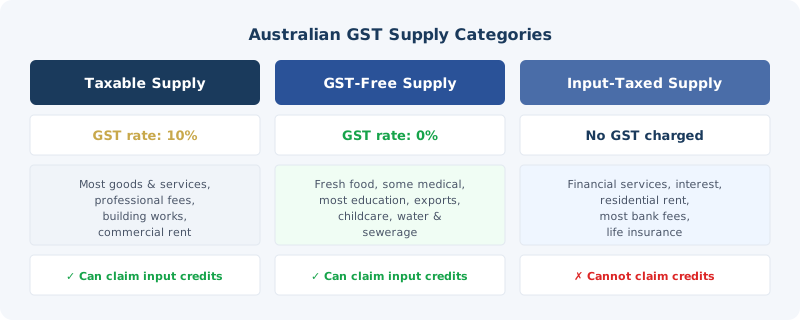
Not everything you sell or buy in Australia attracts GST. The ATO divides all supplies into three categories: taxable (10% GST), GST-free (0% GST but still creditable), and input-taxed (no GST, no credits). Understanding the difference matters for every invoice you issue and every purchase you claim.
The Difference Between GST-Free and Input-Taxed
Before jumping to the list, this distinction is worth knowing clearly.
GST-free supplies attract no GST (you charge 0%), but you can still claim input tax credits on business purchases you make to provide them. A GP doesn't charge GST on a patient consultation, but can still claim credits on clinic equipment, software, or office rent.
Input-taxed supplies are different. You also don't charge GST, but you cannot claim credits on costs related to providing them. Residential property investors don't charge GST on rent, and they can't claim credits on property maintenance costs either.
This is a critical distinction. If you misclassify an input-taxed supply as GST-free and claim credits you're not entitled to, you'll face a BAS adjustment and possible penalties.
Basic Food: The Biggest GST-Free Category
Most basic food items are GST-free under the A New Tax System (Goods and Services Tax) Act 1999. The core principle: food for human consumption is GST-free, but prepared and takeaway food generally isn't.
GST-free food includes:
- Fresh fruit and vegetables
- Meat, poultry, and seafood (not cooked)
- Bread and bread rolls
- Cereals and grains
- Dairy products like milk, cheese, butter, and yoghurt
- Eggs
- Cooking oils and fats
- Bottled water and plain milk drinks
Food that does attract GST:
- Hot food sold for immediate consumption (hot chips, roast chook from a supermarket rotisserie)
- Restaurant, café, and takeaway meals
- Confectionery, soft drinks, flavoured milk
- Savoury snacks (chips, crackers)
- Ice cream and similar products
- Alcohol
The line can be genuinely confusing. Plain water is GST-free. Flavoured sparkling water may be taxable. A cold sandwich from a deli is GST-free; a hot toasted sandwich is taxable. When you're unsure, use our GST calculator to model the correct price to charge, and check the ATO's detailed food classification guide for edge cases.
Medical and Health Services
GST-free medical services include:
- Most services provided by a registered medical practitioner (GP, specialist)
- Hospital treatment services
- Pathology tests and diagnostic imaging
- Dental services provided by a registered dentist
- Most pharmaceutical drugs listed on the Pharmaceutical Benefits Scheme (PBS)
- Optometry services
Not GST-free:
- Cosmetic procedures performed for cosmetic reasons (not medically necessary)
- Over-the-counter medicines (non-PBS)
- Some alternative health services (depending on provider registration)
- Gym memberships (even if recommended by a doctor)
Pharmaceutical companies, pharmacies, and healthcare providers deal with mixed supplies constantly, with some items GST-free and others taxable. Accurate records are essential. An accountant familiar with health industry GST rules is worth consulting if you run a practice.
Education
Most education courses are GST-free when provided by an approved education provider. This includes:
- Primary and secondary schooling
- TAFE and vocational education courses
- University courses
- Most professional development provided by registered training organisations (RTOs)
School fees, university tuition, and TAFE course fees carry no GST. Textbooks sold by a university bookshop are taxable, even if required for a GST-free course. School uniforms are taxable. Canteen food follows the food rules above.
Private tutoring is generally taxable unless provided by an approved institution.
Childcare
Approved childcare services are GST-free. This covers:
- Long day care
- Family day care
- Outside school hours care
- Vacation care
- Occasional care centres
Fees charged by approved childcare centres don't attract GST. Nannies and babysitters providing private care (not through an approved centre) are generally providing taxable services if they're GST-registered.
Exports
Goods and services exported from Australia are GST-free. This is one of the more straightforward categories:
- Physical goods shipped overseas to an overseas buyer
- International transport of goods and passengers
- Services provided to non-residents who consume them outside Australia
If you're an Australian business selling to overseas customers, those sales are GST-free, but you must keep export documentation to support your GST-free treatment. Our guide on GST on imported goods covers the reverse side: when overseas purchases come into Australia and how GST applies.
Water and Sewerage Services
Water and sewerage services supplied by government entities are GST-free. Bottled water from a private company follows food rules (usually GST-free as plain water for consumption).
Precious Metals
Gold, silver, and platinum in investment form (specifically, refined precious metals of at least 99.5% purity for gold and 99.9% for silver and platinum) are GST-free when sold to an investor for the first time in Australia.
Who Needs to Know This
If you run a business that sells a mix of taxable and GST-free products, you need to be particularly careful. Supermarkets, pharmacies, health food stores, and catering businesses are common examples. For each transaction, the correct GST treatment must be applied, and your BAS must accurately separate GST-free turnover from taxable turnover.
Use our Australian GST calculator to verify the right GST component on any transaction. For complex mixed supply situations (where a single sale includes both GST-free and taxable elements), consult a registered tax agent or read our guide on common GST mistakes to avoid misclassification issues.
The ATO website has a detailed GST supply classification tool if you're dealing with an unusual item not covered here. The legislation is the A New Tax System (Goods and Services Tax) Act 1999, and the ATO publishes Goods and Services Tax Rulings (GSTRs) on specific categories when the law needs interpretation.
Key Takeaways
The three categories every Australian business needs to understand are taxable (10% GST), GST-free (no GST charged, but input tax credits still available on your costs), and input-taxed (no GST charged and no credits available). Getting these classifications wrong can mean either overcharging customers or missing credit claims on your BAS.
The most common GST-free categories are basic fresh food, most medical services, approved education courses, childcare, and goods or services exported overseas. Alcohol, restaurant meals, hot takeaway food, and cosmetic procedures are taxable.
If your business sells a mix of taxable and GST-free items, your accounting software should apply the correct GST code to each line. On your BAS, only the taxable portion contributes to your GST collected figure.
For quick verification of the GST component on any purchase or sale, our GST calculator gives you the breakdown in seconds. Visit our about page for details on the methodology behind our calculations. If you're unsure how to classify a specific product or service, the ATO's GST supply classification tool and the published Goods and Services Tax Rulings are the authoritative references.
Keep a note of your supply categories when you set up your accounting software. Getting them right from the start means your BAS reporting is accurate every quarter without extra work.