8 Common GST Mistakes Australian Businesses Make
Avoid the most frequent Australian GST errors. From late registration to misclassifying supplies, these mistakes cost businesses money. Here's how to fix them.
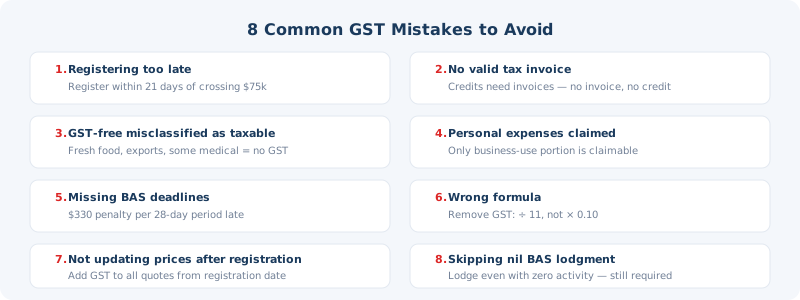
Quick Answer: The 8 most common Australian GST mistakes are: registering too late, claiming credits without valid tax invoices, misclassifying GST-free supplies, including personal expenses in credit claims, missing BAS due dates, using the wrong formula, forgetting to update prices after registration, and not lodging a nil BAS. Most are avoidable with basic systems.
GST mistakes fall into two categories: ones that cost you money and ones that get you in trouble with the ATO. Often both. After years of BAS lodgments, these eight errors come up repeatedly, and every single one is preventable.
Mistake 1: Registering Too Late
The law requires you to register within 21 days of reaching the $75,000 annual GST turnover threshold. Many sole traders only discover they crossed it when doing their annual tax return, often 10 months after the fact.
When you register late, you typically owe the ATO GST on all taxable sales from when you should have registered. If you billed $90,000 over eight months and never charged GST, the ATO can assess you for $90,000 ÷ 11 = approximately $8,182 in unremitted GST. That's out of your own pocket.
Fix: Monitor your rolling 12-month turnover monthly. Use a simple spreadsheet or accounting software. When you hit $65,000, start preparing to register. Read our complete guide on when the $75,000 threshold applies.
Mistake 2: Claiming Credits Without a Valid Tax Invoice
You cannot claim a GST input tax credit on a purchase over $82.50 without holding a valid tax invoice from the supplier. Many business owners claim credits based on EFTPOS receipts that show a transaction amount but not the supplier's ABN or the words "Tax Invoice."
In an ATO audit, credits claimed without valid documentation are disallowed, with interest accruing from the original BAS period.
Fix: For every purchase over $82.50, obtain and file the tax invoice before lodging your BAS. If a supplier can't provide one, ask why. They may not be GST-registered, meaning their prices carry no GST and there's nothing to claim anyway. Use our Australian GST calculator to verify the credit amounts.
Mistake 3: Treating GST-Free Items as Taxable
Selling fresh food, providing certain medical services, or exporting goods? These are GST-free. You don't charge GST on them. But some businesses inadvertently add GST to GST-free supplies, overcharging customers and then failing to remit correctly on their BAS.
The reverse also happens: treating a taxable supply as GST-free and never charging GST on it, then being assessed when the ATO reviews the BAS.
Fix: Know your supply categories. Our guide on GST-free items in Australia covers every major category with clear examples. If you have mixed supplies, get accounting software that supports GST codes per line item.
Mistake 4: Claiming Credits on Personal Expenses
A business credit card used for the office Christmas dinner, personal groceries picked up on a business run, a family holiday mistakenly coded as a business travel claim. These invalid credits are commonly flagged in ATO data matching.
The ATO cross-references credit card merchant categories, ABN data, and income patterns. A $30,000 business expense account from a sole trader earning $80,000 in a service business gets scrutiny.
Fix: Keep business and personal expenses strictly separate. Different bank accounts and cards. If genuinely mixed (phone, internet, home office), apply a documented business-use percentage and claim only that portion of the GST.
Mistake 5: Missing BAS Due Dates
Quarterly BAS deadlines are fixed (late October, late February, late April, late July, with a two-week online lodgment extension). Missing them attracts a failure-to-lodge penalty: $330 per 28-day period, capped at $1,650 for most businesses.
Beyond the penalty, late payment of GST owing attracts the general interest charge, currently around 8-9% per annum, calculated daily.
Fix: Put all four BAS due dates in your calendar on 1 July each year. Set a reminder two weeks before each deadline to start gathering figures. If you can't pay the full amount by the due date, still lodge on time. Penalties for late lodgment are separate from late payment.
Mistake 6: Using the Wrong Formula
The most common arithmetic error: dividing an ex-GST price by 1.10 instead of multiplying, or multiplying an inclusive price by 1.10 to "find the GST" instead of dividing by 11.
Example of the error: A business receives a $1,000 invoice (inclusive of GST) and calculates the GST as $1,000 × 0.10 = $100. Wrong. The correct calculation is $1,000 ÷ 11 = $90.91.
The difference seems small per transaction, but across 200 purchases in a quarter, it compounds.
Fix: Use our GST calculator for every calculation. The correct formulas are covered in detail in our GST formula guide. The single most important thing to remember: when removing GST from an inclusive price, divide by 11.
Mistake 7: Not Updating Prices After Registration
A newly registered business that forgets to update its price lists ends up effectively absorbing the GST itself. If you quoted $1,000 for a service before registration and charge $1,000 after registration (now meaning $909.09 + $90.91 GST), you've cut your margin.
Clients may push back, especially consumers. Business clients, who claim back the GST anyway, usually don't mind since the net cost to them is unchanged.
Fix: On registration, immediately update every quote template, rate card, website pricing page, and ongoing contract. Email key clients in advance of the change. For fixed-price contracts signed before registration that extend beyond your registration date, seek legal advice on whether you can pass on the GST or need to absorb it.
Mistake 8: Not Lodging a Nil BAS
Zero business activity in a quarter? You still need to lodge a BAS showing zero. Many new business owners skip this, assuming a nil BAS isn't required. The ATO's system expects a submission and generates a failure-to-lodge notice if none arrives.
Fix: Even during slow quarters, log into the ATO portal and submit a nil BAS. It takes two minutes. The penalty for not doing so is the same as for any other late BAS: $330 per 28-day period.
Building a System to Avoid These Mistakes
The businesses that never make these errors have one thing in common: they treat BAS preparation as a quarterly admin routine, not a crisis response. They use accounting software (or at minimum a clean spreadsheet), file invoices in real time, and reconcile monthly so there are no surprises.
If you're starting out, set aside 30 minutes each month to review transactions, confirm invoice records are complete, and verify that your GST calculations are accurate. By the time BAS day arrives, you'll have nothing to do except add up the figures. Review our team's approach on the about page, and if you want to audit past BAS returns, a registered BAS agent can review your records for a single flat fee.
Key Takeaways
The eight most common Australian GST mistakes all share one root cause: not treating GST administration as a regular, systematic process. Businesses that do BAS preparation once a quarter as a crisis typically make more errors than those that check transactions monthly.
The costliest mistakes tend to be late registration (where you owe GST on past sales you never collected), invalid credit claims (disallowed in audit with interest), and misclassifying supplies. All three come from not having clear processes in place before you need them.
Use our Australian GST calculator to verify the GST component of every transaction you're unsure about. For $2,640 inclusive, the GST is $240 and the net is $2,400. Two seconds of verification prevents a potentially expensive BAS error.
Our about page covers the methodology we use, and our guides on registering for GST and lodging your BAS give you the compliance framework to avoid these mistakes from day one.