The $75,000 GST Threshold: When You Must Register
Understand the Australian GST registration threshold of $75,000. Learn how to calculate your GST turnover, what counts, and when voluntary registration makes sense.
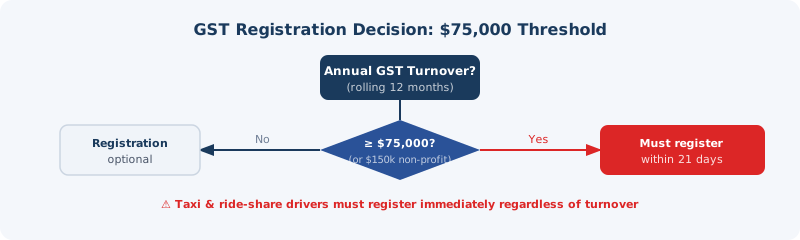
Quick Answer: You must register for GST when your GST turnover reaches $75,000 in a 12-month period (or $150,000 for non-profits). GST turnover is your gross business income before expenses, not profit. Taxi and ride-share drivers must register regardless of turnover.
The $75,000 threshold is one of the most important numbers in Australian small business tax. Cross it and your obligations change significantly. Stay below it and you have a choice. Get the threshold calculation wrong and you could owe the ATO GST you haven't collected, which means it comes out of your own income.
What Exactly Is "GST Turnover"?
GST turnover is not your profit. It's not your bank deposits. It's the total value of taxable and GST-free supplies you make, which is your gross business income before any deductions.
Included in GST turnover:
- Payment for goods and services you provide
- Income from contracts and work completed
- Royalties and licensing fees from business activities
- GST-free supplies (yes, these count even though they carry no GST)
Excluded from GST turnover:
- Input-taxed supplies (residential rent, financial services)
- Capital asset sales (selling your business vehicle is usually excluded)
- Private income (salary from an employer, investment income)
- Overseas income in some circumstances
So if you're a freelance designer earning $70,000 from clients and $8,000 from renting out a room in your house (residential rent, which is input-taxed),, your GST turnover is $70,000. The rental income doesn't count. You're under the threshold.
If you earn $70,000 from design clients and $8,000 from selling stock photography online, your GST turnover is $78,000. You must register.
Use our Australian GST calculator to model the GST implications once you cross the threshold and start adding tax to your prices.
The Two Calculations: Projected and Current
The ATO applies the threshold in two ways, and you need to check both:
Current annual turnover: Your actual GST turnover over the past 12 months (any rolling 12-month period, not just a financial year). If this hits $75,000, you're over the threshold now.
Projected annual turnover: What you expect to earn in the current month plus the next 11 months. If you sign a big contract in March that takes your projected annual figure to $90,000, you should register even if you haven't earned that much yet.
The ATO expects you to register before you exceed the threshold, not after. If you cross it without registering, you owe GST on all taxable sales from the date you should have registered. That means you may need to remit GST on revenue where you never charged the client GST. That comes directly off your income.
Timeline: When to Register
You must apply to register within 21 days of becoming aware your threshold has been or will be exceeded.
Practically: monitor your rolling 12-month turnover monthly. When you're at $65,000, start preparing. Update your price lists, invoice templates, and client communication. Give yourself at least two weeks before you expect to cross the threshold to get registered and operational.
The $150,000 Threshold for Non-Profits
Non-profit organisations have a higher threshold of $150,000 annual GST turnover before mandatory registration applies. This covers charities, community groups, sporting clubs, and similar entities. The same voluntary registration option exists below the threshold, and the same ride-share driver exemption applies. A not-for-profit running a community transport service with Uber-connected vehicles still registers immediately.
Voluntary Registration Below $75,000
You can choose to register for GST even if your turnover is below $75,000. Reasons to consider it:
Reclaim startup costs. If you're spending heavily on equipment, premises fit-out, or professional services to establish your business before you have much revenue, GST registration lets you claim input tax credits on those costs immediately. A café spending $40,000 on kitchen equipment before opening can reclaim $3,636 in GST credits.
Look more established. Some larger clients require their suppliers to be GST-registered. Being registered signals a degree of business formality. For B2B services businesses aiming at corporate clients, this can matter.
Simpler transition. If you expect to cross $75,000 within 12 months anyway, registering now avoids the scramble later and gives you time to set up your accounting systems properly.
The downside: you take on BAS lodgment obligations and administration that unregistered businesses don't have. For a low-turnover sole trader with personal clients, the added compliance cost may outweigh the benefits.
Crossing the Threshold Mid-Year
Most businesses don't cross the threshold at the start of July. They cross it in March, October, or February. When you cross mid-year:
- Register within 21 days
- Start charging GST from your registration date (not retrospectively from 1 July)
- Issue updated invoices and quotes that include GST from the registration date
- Let existing clients know, especially if you have ongoing retainers or repeat work
Contracts and ongoing arrangements signed before registration may need price renegotiation. Many business-to-business clients won't mind since they'll claim the GST back anyway. Consumers may push back on the effective price increase. Be transparent about it.
The Ride-Share Exception: No Threshold
As noted, anyone who drives for a ride-sharing platform (Uber, DiDi, Ola, Shebah) or operates a taxi must register for GST from the first trip. No threshold applies. This has been law since 2015 and the ATO actively crossreferences ride-share income data with driver registrations.
A part-time Uber driver earning $18,000 a year must register, charge GST (technically already factored into the Uber fare structure), and lodge quarterly BAS. Penalties for non-compliance can be substantial given the ATO's access to Uber's income data.
Once you're registered, use our Australian GST calculator for daily use and review our guide on common GST mistakes to avoid the errors that catch newly registered businesses off guard. If you're uncertain whether your specific income sources count toward the threshold, a registered tax agent can assess your situation in a single consultation.
Key Takeaways
The $75,000 GST registration threshold applies to most Australian businesses. Non-profits get a higher threshold of $150,000. Ride-share and taxi drivers must register immediately regardless of turnover.
GST turnover is gross business income, not profit. Input-taxed supplies (like residential rent) don't count toward the threshold, but GST-free supplies (like most food or exports) do.
You must register within 21 days of knowing your turnover has reached or will reach the threshold. Registering late means owing GST on past sales at your own expense. Early monitoring at the $65,000 mark gives you time to prepare.
Voluntary registration below $75,000 can be worthwhile if you have significant startup costs or want to claim credits on early purchases. The administration burden of quarterly BAS is the main trade-off.
Use our Australian GST calculator to see exactly what your prices look like with GST added, and read our full registration guide for the step-by-step process.
If you're close to the threshold and unsure whether a particular income stream counts toward your GST turnover, a single consultation with a tax agent can give you clarity. It's easier to get the answer right in advance than to work backwards after a late registration assessment.
The $75,000 threshold has remained unchanged since the GST was introduced in 2000. Keep an eye on your rolling annual turnover each month and you'll never be caught unprepared.