How to Register for GST in Australia (2026 Guide)
Step-by-step guide to registering for Australian GST. Learn when you must register, how to apply through the ATO, and what happens after registration.
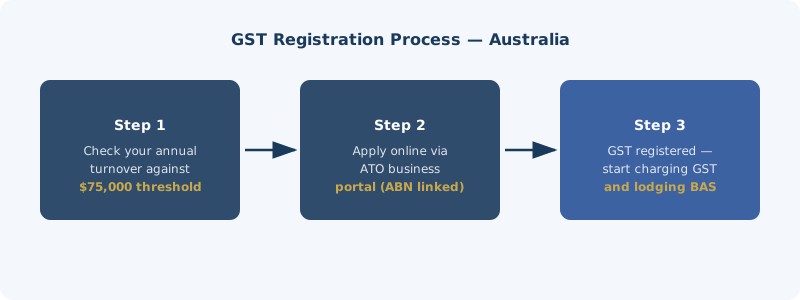
Quick Answer: Register for GST online through the ATO Business Portal or myGovID. You need an ABN first. Registration typically takes 2–5 business days. You must register once your annual GST turnover reaches $75,000 (or $150,000 for non-profits).
Most Australian sole traders and small business owners have a specific date that sticks in their memory: the day they crossed the $75,000 turnover threshold and had to figure out GST. If you're approaching that figure, or you've already passed it, this guide walks through exactly what you need to do.
Do You Actually Need to Register?
The mandatory threshold is $75,000 in annual GST turnover. This applies to most businesses: sole traders, companies, partnerships, and trusts. Non-profit organisations have a higher threshold of $150,000.
GST turnover is your gross business income before expenses, not your profit. If you run a consultancy and bill $80,000 in a year but spend $40,000 on costs, your GST turnover is still $80,000. You must register.
There are two situations where you must register regardless of turnover:
Taxi and ride-share drivers must register from day one. Driving for Uber, DiDi, or Ola counts. The ATO is explicit about this. Even part-time drivers with $15,000 annual income must register and charge GST on fares.
New businesses expecting to reach $75,000 within 12 months should register proactively. If you start a business and genuinely expect to hit the threshold in your first year, you're required to register before you exceed it, not after.
You can also register voluntarily below the threshold. Many businesses do this to claim input tax credits on startup costs. If you spend $50,000 setting up equipment but earn nothing yet, being GST-registered lets you claim back $4,545 in GST credits. For capital-intensive startups, this matters.
What You Need Before Registering
You'll need an Australian Business Number (ABN) before you can register for GST. If you don't have one, apply for an ABN first through the Australian Business Register. It's free and usually processed within a few minutes online.
You'll also need to decide your reporting period: quarterly, monthly, or annual.
- Quarterly: standard for most businesses. Due dates fall roughly one month after each quarter end.
- Monthly: required if your annual GST turnover is $20 million or more. Optional for others who prefer more frequent reporting.
- Annual: available to some businesses with simple tax affairs. Check the ATO website for eligibility, as specific criteria apply.
Quarterly is right for most small businesses. It means less paperwork and fewer deadlines to track.
Step-by-Step Registration Process
Using the ATO Business Portal
The most straightforward path is through the ATO's online services. Log in with your myGovID credentials (previously AUSkey). If you don't have myGovID set up, you'll need to do that first. It's the ATO's identity verification system for business owners.
Once logged in:
1. Go to Manage registrations in the portal
2. Select Register for GST
3. Confirm your ABN details
4. Choose your reporting period (quarterly recommended for most)
5. Provide your bank account details for refunds
6. Submit
Registration is usually confirmed within 2–5 business days. You'll receive written confirmation by mail or through the portal.
Via Your Registered Tax Agent
If you work with an accountant or registered tax agent, they can register GST on your behalf through their professional access to ATO systems. This is worth considering if you're also setting up other registrations at the same time (PAYG withholding, fringe benefits tax, etc.). An agent can handle the lot in one session.
By Phone
The ATO business line (13 28 66) can process registration over the phone. Have your ABN, personal identification, and business details ready. Wait times vary; the online portal is usually faster.
What Happens After Registration
Once registered, you have three core obligations from your registration date:
Charge GST on taxable sales. Add 10% to your prices (or include GST in quoted prices and make sure the GST component is clear on invoices). Use our Australian GST calculator to work out the right figures for each transaction.
Issue tax invoices. For sales over $82.50 (GST-inclusive), you must provide a tax invoice when a customer asks for one. A valid tax invoice must include your ABN, the words "Tax Invoice", the GST amount, and the date. Read our detailed guide on how to write a GST invoice for the full requirements.
Lodge Business Activity Statements. Report your GST collected and GST credits claimed on your BAS, and pay the net amount to the ATO (or receive a refund if credits exceed collected GST). If you're new to BAS, our step-by-step guide on lodging your BAS covers the whole process.
Common Registration Mistakes
Registering on the wrong date. Your registration date determines when you start charging GST. If you register too late (after you've already exceeded the threshold), you may need to remit GST on sales made before registration, which comes out of your own pocket.
Forgetting to update your prices. After registration, your quotes and invoices need to reflect GST. If you were quoting $1,000 for a job and now need to charge $1,100, update your rate cards and templates immediately. Contracts signed before registration that covered the threshold date can create complications, so consult a tax agent if in doubt.
Not understanding your reporting period. If you register for quarterly BAS but your turnover crosses $20 million, you're required to switch to monthly. The ATO will notify you, but keeping track of your turnover avoids surprises.
After Registration: Your First Quarter
Your first BAS period runs from your registration date to the end of the quarter. During that time:
- Record all GST-inclusive sales (your GST collected)
- Record all GST-inclusive purchases with valid tax invoices (your input tax credits)
- Use your accounting software or a spreadsheet to separate the GST component
At quarter end, calculate the difference. If you collected $3,000 in GST and have $1,200 in credits, you owe the ATO $1,800. If credits exceed collections (which sometimes happens in a startup phase with large equipment purchases), the ATO refunds the difference.
Calculate each transaction accurately from the start. Our GST calculator takes two seconds per amount and ensures you record the right figures in your books.
Registering for GST is a sign your business is growing. Get it set up correctly, understand your obligations, and talk to our team or a registered tax agent if anything is unclear. The ATO website also has detailed guidance under "GST registration" if you want to go deeper.
Key Takeaways
Register for GST when your annual GST turnover reaches $75,000 ($150,000 for non-profits), or from the moment you start driving for a ride-sharing or taxi service. You must apply within 21 days of crossing the threshold.
The registration process goes through the ATO Business Portal, requires an existing ABN, and takes 2-5 business days for confirmation. Quarterly BAS reporting is the standard choice for most small businesses.
Once registered, three obligations kick in from your registration date: charge GST on taxable sales, issue valid tax invoices, and lodge BAS quarterly (or monthly if turnover exceeds $20 million).
The most common mistake is registering late and owing GST on past sales you never collected. Monitor your rolling 12-month turnover monthly. When you reach $65,000, prepare to register. Our GST calculator helps you model what your prices will look like with GST included. The about page has more on the formulas and methodology we use.