GST on Property in Australia: What Buyers and Sellers Need to Know
A plain-English guide to GST on Australian property. Covers new residential premises, commercial property, the margin scheme, and going concern sales.
Quick Answer: GST applies to the sale of new residential premises and commercial property in Australia. Existing residential properties are generally input-taxed and carry no GST. The margin scheme can reduce GST on eligible new property sales. Rental income from residential property is input-taxed; commercial rent is taxable.
Property transactions in Australia involve some of the most complex GST rules you'll encounter. Get it right and you save tens of thousands. Get it wrong and the ATO may assess GST you weren't expecting, or disallow credits you were counting on.
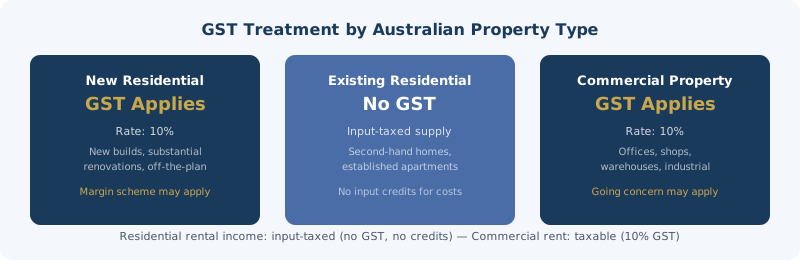
The Key Distinction: New vs Existing Residential Property
Existing residential property (a second-hand house, apartment, or unit that has been sold and lived in before) is an input-taxed supply. No GST is charged on the purchase price, and the seller cannot claim GST credits on sale costs. This is the most common property transaction in Australia: buying an established home or investment property.
New residential premises (newly built homes, newly converted properties, and property that has been substantially renovated) attract GST at 10%. The developer or seller charges GST, and the purchaser cannot claim an input tax credit (because they're buying for private residential use, not a business purpose).
What Counts as "New"?
A property is classified as new if:
- It has never been sold as a residence before (new construction)
- It was substantially renovated (not just a kitchen upgrade; the entire structure must be effectively rebuilt or replaced)
- It was previously non-residential (commercial, industrial) and is now being used residentially for the first time
A property that was tenanted as a rental for two years and then sold is existing and GST-free on sale. A new display home being sold by a developer for the first time is new and subject to GST.
Calculating GST on New Property
For a standard new property sale, the GST calculation is straightforward. The developer charges 1/11th of the contract price as GST.
A new apartment priced at $880,000 (GST-inclusive): GST = $880,000 ÷ 11 = $80,000. Net price = $800,000.
Use our Australian GST calculator: select "Remove GST" and enter the contract price to see the breakdown instantly.
However, new property sales often use the margin scheme, which changes how GST is calculated.
The Margin Scheme
The margin scheme allows eligible property developers to pay GST on only the profit margin (the difference between the sale price and their acquisition cost) rather than on the full sale price. This can significantly reduce the GST payable.
Standard GST (no margin scheme): A developer buys land for $400,000 and sells new apartments for $1,100,000 (incl. GST). GST = $1,100,000 ÷ 11 = $100,000.
With margin scheme: Same scenario. Margin = $1,100,000 − $400,000 = $700,000. GST = $700,000 ÷ 11 = $63,636.
The margin scheme must be agreed to in writing between buyer and seller before settlement. The buyer cannot claim input tax credits on a margin scheme purchase. They pay a lower price and get no credit.
Eligibility conditions apply. The ATO has detailed guidance on margin scheme eligibility, including how to treat acquisitions made under different circumstances (pre-GST land, subdivided lots, etc.). This is specialist territory. A property lawyer or tax advisor with GST experience should review any significant new property development.
Commercial Property
Commercial real estate (offices, retail shops, warehouses, industrial premises) is generally a taxable supply when sold. GST applies at 10%, and the purchaser who is buying for business purposes can claim input tax credits.
A commercial property selling for $2,200,000 (GST-inclusive): GST = $2,200,000 ÷ 11 = $200,000. A GST-registered purchaser using the property for business claims this $200,000 as an input tax credit on their BAS.
The going concern exemption applies when a business is sold as a going concern, meaning all assets and the operational business transfer as a complete functioning entity. Under the going concern exemption, the sale is GST-free. Both parties must be GST-registered and must agree in writing before the sale that the going concern exemption applies. Missing the written agreement can mean GST becomes unexpectedly payable.
Rental Income: Residential vs Commercial
Residential rent is an input-taxed supply. Landlords who rent out houses and apartments don't charge GST on rent, and they can't claim input tax credits on property costs (maintenance, agent fees, rates).
Commercial rent is taxable. A commercial landlord charges GST at 10% on rent and can claim credits on building costs. A tenant who is GST-registered can claim credits on the GST portion of their rent.
For mixed-use properties (say, a building with retail downstairs and residential upstairs), GST applies to the commercial portion and not the residential. Apportionment is required, and a property accountant's input is advisable.
What Property Buyers Should Check
Before exchanging contracts on any property, confirm:
1. Is GST included in the price? (Contract should state "plus GST" or "GST-inclusive")
2. Is the margin scheme being applied? (Can't claim input credit if so)
3. Is the going concern exemption being relied on? (Requires written agreement)
4. Is the supply GST-free (existing residential)? (Usually no GST on settlement statement)
For commercial property buyers who are GST-registered, the GST is ultimately recoverable as a credit, making it a timing cost rather than a permanent one. For residential property buyers, GST is embedded in the price and non-recoverable.
The ATO publishes Goods and Services Tax Ruling GSTR 2003/3 on residential premises and GSTR 2009/2 on going concerns for those wanting the legislative detail. Property transactions above $750,000 are also subject to Foreign Resident Capital Gains Withholding considerations, adding another layer for overseas purchasers.
For general GST calculations on property transactions, our GST calculator gives you the accurate breakdown in seconds. For anything more complex, the cost of a one-hour consultation with a property tax specialist is insignificant compared to the potential GST exposure. Read our guide on common GST mistakes to understand the errors that most often appear in property transactions.
Key Takeaways
The essential property GST rule: existing residential property is input-taxed (no GST), new residential property is taxable (10% GST), and commercial property is generally taxable. Residential rent is input-taxed; commercial rent is taxable.
The margin scheme can significantly reduce the GST payable on new property development. But it must be agreed in writing before settlement, and the buyer cannot claim input tax credits on a margin scheme purchase.
For the going concern exemption to apply to a commercial property or business sale, both parties must be GST-registered and the written agreement must be in place before settlement. Missing the paperwork can mean an unexpected GST liability.
Before signing any property contract, confirm whether GST is included, which scheme applies, and whether you can claim credits. Our GST calculator handles the arithmetic for any GST-inclusive amount. For complex property transactions, the investment in specialist tax advice is usually insignificant compared to the potential GST exposure. You can also read more about our editorial team and methodology.
Property GST is an area where specialist advice pays for itself. The rules are well-defined, but the consequences of misapplying them on a $1 million+ transaction can be significant. A one-hour consultation before signing a contract is money well spent.